
Yu Sleep – Potent Natural Ingredients for Deep Sleep and Nightly Recovery
Getting enough high-quality sleep is essential for physical recovery, mental performance, mood, and overall well-being. Yet many people struggle to fall asleep, quiet their minds at night, or maintain a consistent sleep schedule.
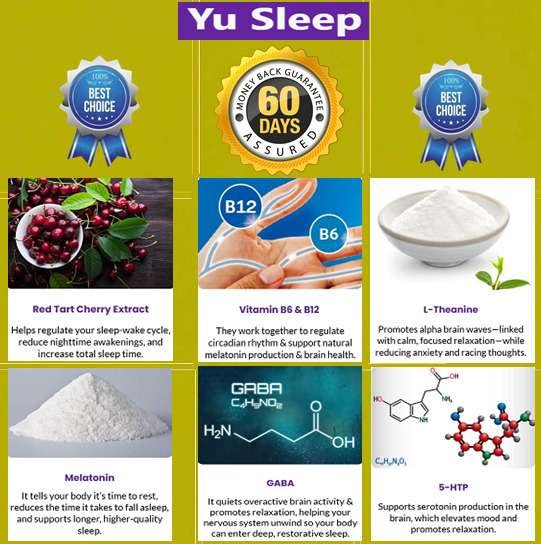
YuSleep Ingredients are designed around several pathways involved in normal sleep regulation, combining melatonin, amino acids, vitamins, and plant-derived compounds. The formula includes Red Tart Cherry Extract, 5-HTP, L-Theanine, GABA, Vitamin B6, Vitamin B12, and Melatonin.
Rather than looking at these ingredients individually, it is useful to understand how they may complement different aspects of the body’s sleep process, including relaxation, neurotransmitter production, melatonin signaling, and circadian rhythm support.
Importantly, research on individual ingredients does not automatically prove that the finished YuSleep formula will produce the same results. The amount, formulation, timing, and combination of ingredients all matter.
What Are the Main YuSleep Ingredients?
According to the information provided for YuSleep, the formula contains:
- Red Tart Cherry Extract
- 5-HTP (5-Hydroxytryptophan)
- L-Theanine
- GABA (Gamma-Aminobutyric Acid)
- Vitamin B6
- Vitamin B12
- Melatonin
Each ingredient has a different proposed role. Some are associated with relaxation, while others participate in the biological pathways involved in serotonin, melatonin, or circadian regulation.
Let’s take a closer look at the science behind each ingredient.
1. Red Tart Cherry Extract
Red tart cherry extract is one of the most interesting plant-based ingredients in YuSleep because tart cherries naturally contain melatonin and other compounds that may be relevant to sleep.
Melatonin is a hormone involved in regulating the body’s sleep-wake cycle. Tart cherries, particularly Montmorency cherries, have been investigated as a dietary source of melatonin.
In a randomized, double-blind, placebo-controlled crossover study involving 20 healthy adults, researchers found that consuming tart cherry juice concentrate increased urinary melatonin levels. The study also reported improvements in total sleep time and sleep efficiency compared with placebo.
However, the evidence is not completely consistent. More recent randomized research has failed to find significant improvements in sleep from commonly used tart cherry supplementation. A 2024 study involving adults with overweight or obesity found no significant improvements in sleep measures after 14 days of Montmorency tart cherry powder supplementation.
Another study published in 2026 likewise reported no significant differences in sleep time or sleep quality between Montmorency tart cherry and placebo groups.
This suggests that tart cherry extract is promising but not conclusively proven as a standalone sleep treatment.
Within YuSleep, its role is primarily positioned around supporting the body’s natural melatonin and sleep signaling.
2. 5-HTP (5-Hydroxytryptophan)
5-HTP is an intermediate involved in the body’s production of serotonin.
The biological pathway is important because tryptophan can be converted into 5-HTP, which can then be converted into serotonin. Serotonin can subsequently participate in the biochemical pathway leading to melatonin production. A scientific review describes 5-HTP as an intermediate in serotonin and melatonin biosynthesis.
This is why 5-HTP is often included in formulas designed to support relaxation, mood, and sleep.
However, it is important not to oversimplify the pathway. Taking 5-HTP does not guarantee that the body will produce a particular amount of serotonin or melatonin, and human evidence for using 5-HTP specifically for sleep is more limited than the basic biochemical pathway might suggest.
For YuSleep, 5-HTP can therefore be viewed as a precursor ingredient supporting neurotransmitter pathways associated with sleep regulation, rather than as a sedative.
Why 5-HTP and Vitamin B6 Are Combined
Vitamin B6 is relevant because its active coenzyme form, pyridoxal-5′-phosphate, participates in reactions involving neurotransmitter synthesis.
Research has demonstrated the involvement of vitamin B6-dependent enzymes in the conversion of 5-HTP into serotonin.
This provides a scientific rationale for including B6 alongside 5-HTP, although it does not mean that taking additional B6 will necessarily increase sleep quality in people who already consume adequate amounts.
3. L-Theanine
L-Theanine is a naturally occurring amino acid found primarily in tea leaves. Unlike conventional sedative compounds, L-theanine is generally studied for its ability to promote relaxation without necessarily causing strong sedation.
This makes it particularly interesting for people whose difficulty sleeping is associated with mental tension or an active mind at bedtime.
A 2025 systematic review examined 13 dietary supplementation trials involving 550 participants. The researchers reported potential improvements in several sleep-related outcomes, including sleep onset, sleep maintenance-related measures, perceived sleep quality, and feelings of refreshment. They concluded that current evidence was promising but that additional high-quality research is still needed.
Another 2025 systematic review and meta-analysis included 19 articles involving 897 participants. It found statistically significant improvements in subjective sleep onset latency, daytime dysfunction, and overall subjective sleep quality, while also noting limitations in the available research.
For this reason, L-theanine is one of the more interesting YuSleep Ingredients for supporting relaxation before bedtime.
4. GABA
GABA, or gamma-aminobutyric acid, is the primary inhibitory neurotransmitter in the central nervous system. In simple terms, GABA is involved in reducing neuronal excitability and helping the nervous system maintain a more balanced state.
This is why GABA is sometimes described as the brain’s “braking system.”
The theory behind including GABA in a sleep formula is straightforward: supporting inhibitory signaling may help the body transition into a more relaxed state before sleep.
There is some human research supporting this possibility. One controlled crossover study found that oral GABA supplementation significantly shortened sleep latency and increased total non-REM sleep time.
However, the overall evidence is mixed. A systematic review of 14 placebo-controlled human studies concluded that evidence for stress benefits was limited and evidence for sleep benefits was very limited. The researchers emphasized that more research is needed before firm conclusions can be made about oral GABA supplementation.
Therefore, GABA should be presented as a potential relaxation-support ingredient, rather than a proven treatment for insomnia.
5. Vitamin B6
Vitamin B6 is an essential nutrient involved in numerous biochemical processes, including amino acid metabolism and neurotransmitter synthesis.
Its relevance to YuSleep comes partly from its involvement in the conversion of 5-HTP into serotonin. As mentioned above, vitamin B6-dependent enzymatic activity participates in this conversion.
Because serotonin is involved in the biochemical pathway leading to melatonin, adequate B6 status is important for normal neurotransmitter metabolism.
However, this does not mean that taking extra B6 automatically improves sleep. Its most straightforward role is as a nutritional cofactor supporting normal metabolic processes.
6. Vitamin B12
Vitamin B12 is another essential vitamin included in YuSleep. It plays important roles in normal neurological function, red blood cell formation, and cellular metabolism.
B12 has also been investigated in relation to sleep-wake patterns and circadian biology. However, the relationship between B12 supplementation and sleep is complex, and evidence does not establish B12 as a standalone sleep aid.
Within the YuSleep formula, B12 is better understood as a nutritional component supporting normal nervous-system and metabolic function, rather than an ingredient that directly induces sleep.
7. Melatonin
Melatonin is perhaps the best-known sleep-related ingredient in YuSleep.
The body naturally produces melatonin, primarily in response to darkness. Its levels typically rise in the evening and help signal that the body should prepare for sleep.
Supplemental melatonin provides an external version of this sleep-timing signal.
Research supports melatonin’s usefulness for certain sleep-related situations. A systematic review and meta-analysis of randomized controlled trials found that melatonin supplementation had positive effects on several measures of sleep quality, although results varied considerably between studies.
Another meta-analysis found evidence that melatonin can improve sleep onset latency and total sleep time in certain populations, including adults with delayed sleep phase disorder.
More recent research also suggests that timing and dosage matter when using melatonin. A 2024 systematic review and dose-response meta-analysis highlighted differences in outcomes depending on when melatonin was administered and how much was used.
This is particularly relevant to YuSleep because the formula is designed to be taken before bedtime rather than during the daytime.
How YuSleep Ingredients Work Together
The most interesting aspect of YuSleep is the combination of ingredients rather than any single component.
The formula can be viewed as addressing several stages of the transition to sleep:
L-Theanine + GABA → relaxation support
These ingredients are associated with calming or inhibitory pathways that may help reduce mental and physical arousal.
5-HTP + Vitamin B6 → neurotransmitter support
5-HTP participates in serotonin production, while vitamin B6 is involved in the enzymatic conversion of 5-HTP into serotonin.
Serotonin pathway + Melatonin → sleep signaling
Serotonin is involved in the biochemical pathway that leads to melatonin, while supplemental melatonin directly provides a sleep-related timing signal.
Red Tart Cherry Extract + Melatonin → additional melatonin support
Tart cherries naturally contain melatonin and have been studied for their potential effects on melatonin levels and sleep. However, as discussed earlier, clinical findings are mixed.
Vitamin B12 → nutritional and circadian support
B12 contributes to normal neurological and metabolic function and has been investigated in relation to circadian rhythms.
This multi-pathway approach explains the rationale behind the YuSleep Ingredients formula: instead of focusing exclusively on sedation, it combines ingredients associated with relaxation, neurotransmitter metabolism, and sleep timing.
What Does the Science Really Say About YuSleep Ingredients?
There is scientific research behind several individual ingredients in YuSleep, particularly melatonin, L-theanine, GABA, tart cherry, and 5-HTP.
However, it is important to distinguish between evidence for an individual ingredient and evidence for the complete YuSleep product.
For example, clinical trials have investigated melatonin and L-theanine separately, but those studies do not prove that the exact YuSleep formulation will produce identical results.
Similarly, tart cherry research has produced both positive and negative findings. Some studies have reported improved sleep measures, while newer trials have found no significant benefit.
Therefore, YuSleep should be viewed as a dietary supplement designed to support healthy sleep and relaxation, rather than as a treatment for diagnosed insomnia or another medical condition.
Are YuSleep Ingredients Safe?
Safety depends on the specific ingredients, amounts, individual health conditions, and medications being used.
Because YuSleep contains melatonin and ingredients that may affect neurotransmitter pathways, people who take prescription medications—particularly sleep medications, sedatives, or antidepressants—should speak with a healthcare professional before using it.
Pregnant or breastfeeding individuals and people managing medical conditions should also consult a healthcare provider before starting a new sleep supplement.
It is also important to follow the manufacturer’s recommended serving rather than assuming that more will provide better results.
Final Thoughts on YuSleep Ingredients
The YuSleep Ingredients formula combines several nutrients and compounds associated with different aspects of sleep biology. Red tart cherry extract provides a plant-based source of melatonin-related compounds, 5-HTP participates in serotonin production, L-theanine and GABA are included for relaxation support, B6 and B12 provide nutritional cofactors, and melatonin supplies a direct sleep-timing signal.
Scientific evidence is encouraging for some of these ingredients, particularly melatonin and L-theanine, while evidence for others remains mixed or limited.
Ultimately, the strength of YuSleep’s formula comes from its multi-ingredient approach to sleep support. Rather than relying on a single compound, it combines ingredients intended to support relaxation, neurotransmitter pathways, and the body’s natural sleep-wake cycle.
For anyone considering YuSleep, understanding the ingredients—and the actual strength and limitations of the available research—is the best way to make an informed decision.

Scientific References
- Howatson G, et al. Effect of tart cherry juice (Prunus cerasus) on melatonin levels and enhanced sleep quality. European Journal of Nutrition. 2012.
- Hepsomali P, et al. Effects of Oral Gamma-Aminobutyric Acid (GABA) Administration on Stress and Sleep in Humans: A Systematic Review. Frontiers in Neuroscience. 2020.
- Effect of oral γ-aminobutyric acid (GABA) administration on sleep and its absorption in humans. PubMed.
- 5-Hydroxytryptophan: a clinically-effective serotonin precursor. PubMed.
- 5-Hydroxytryptophan (5-HTP): Natural Occurrence, Analysis, Biosynthesis, Biotechnology, Physiology and Toxicology. PMC.
- Examining the effect of L-theanine on sleep: a systematic review of dietary supplementation trials. 2025.
- The effects of L-theanine consumption on sleep outcomes: A systematic review and meta-analysis. Sleep Medicine Reviews. 2025.
- Effect of melatonin supplementation on sleep quality: a systematic review and meta-analysis of randomized controlled trials. Journal of Neurology. 2022.
- Efficacy on sleep parameters and tolerability of melatonin in individuals with sleep or mental disorders: A systematic review and meta-analysis. 2022.
- Tucker RM, et al. Commonly Used Dose of Montmorency Tart Cherry Powder Does Not Improve Sleep or Inflammation Outcomes in Individuals with Overweight or Obesity. Nutrients. 2024.