The Anxiety-Insomnia Loop: Breaking the Cycle That Keeps You Up (In-Depth Guide)
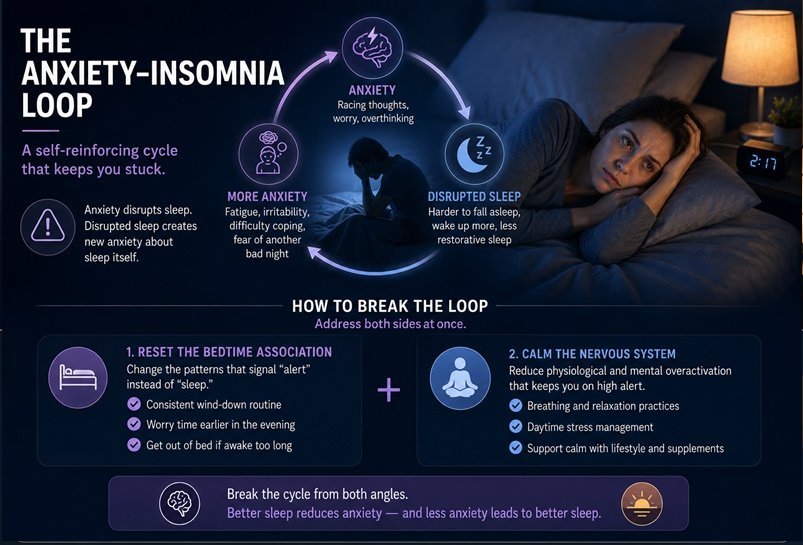
There’s a particular kind of frustration in lying awake, exhausted, while your mind refuses to cooperate — running through tomorrow’s problems, replaying today’s conversations, or simply worrying about the fact that you’re not asleep yet. If this sounds familiar, you’re experiencing one of the most common and most self-reinforcing patterns in sleep difficulty: the anxiety-insomnia loop. Understanding how it works is often the first real step toward breaking it.
How the Loop Actually Forms
The pattern typically starts with a period of genuine, situational stress — a demanding project at work, a difficult life event, ongoing worry about something specific. During this period, it’s completely normal for sleep to be disrupted; an anxious mind and restful sleep are, biologically, somewhat incompatible states.
Here’s where the loop begins to take on a life of its own: after a few nights of poor sleep, a new source of anxiety emerges — anxiety about sleep itself. You start going to bed already worried about whether you’ll be able to fall asleep, which is itself a form of anxious anticipation that makes falling asleep harder, which reinforces the belief that bedtime is something to be anxious about, which makes the next night harder still.
This secondary anxiety often ends up outlasting whatever originally caused the sleep disruption. The original stressor may resolve, but the learned association between bedtime and anxiety persists — which is why insomnia frequently continues well after the situation that triggered it has been resolved.
Why Your Body Treats This Like a Real Threat
From a biological standpoint, anxiety activates your sympathetic nervous system — the same “fight or flight” response designed to keep you alert and ready to respond to danger. This response is fundamentally incompatible with the parasympathetic, “rest and digest” state your body needs to transition into for sleep. Elevated cortisol, increased heart rate, and heightened mental alertness are all useful if you’re facing an actual threat — and all directly counterproductive to falling asleep.
The problem is that your nervous system doesn’t distinguish well between “there’s a real emergency” and “I’m anxious about not being able to sleep.” Both trigger a similar physiological response, which is part of why bedtime anxiety about sleep itself is so effective at preventing the very thing you’re anxious about.
The Racing Thoughts Pattern
A specific hallmark of this loop is the experience of lying in bed with your body physically tired but your mind unable to stop generating thoughts — often unproductive ones, since problem-solving rarely happens effectively at 1 a.m. anyway. This isn’t a character flaw or a sign you’re “bad at relaxing.” It’s a predictable consequence of an activated nervous system combined with the unusual amount of unstructured mental space that bedtime provides — with fewer external distractions competing for your attention, anxious thoughts that were being held at bay during a busy day often surface more forcefully once you’re finally still.
The Clinical Term for This: Conditioned Arousal
Sleep researchers have a specific name for what happens once the loop takes hold: conditioned arousal. Through repeated pairing of “being in bed” with “being anxious and awake,” the bed and bedroom themselves become a learned trigger for alertness rather than sleepiness — a form of classical conditioning, not unlike how a specific sound or smell can trigger a stress response once it’s been repeatedly associated with something stressful. This is part of why many people with chronic insomnia describe falling asleep easily on the couch, in a hotel, or anywhere other than their own bed — the conditioned association is tied specifically to their usual sleep environment, not to sleep itself.
Understanding this distinction matters clinically, because it explains why simply “trying harder” to relax in bed often backfires. You’re not fighting a lack of tiredness — you’re fighting a learned association that needs to be actively unlearned through consistent behavioral change, not willpower in the moment.
Breaking the Loop: Addressing Three Layers at Once
Because this pattern involves multiple interacting problems — the original anxiety, the conditioned bed-arousal association, and the ongoing physiological nervous system activation — effectively breaking it usually requires addressing all three, not just one. This layered approach is essentially the model behind cognitive behavioral therapy for insomnia (CBT-I), which is recognized as the first-line, evidence-based treatment for chronic insomnia by major sleep medicine bodies, and which research continues to show produces meaningful, often long-lasting improvements in both time to fall asleep and total sleep quality.[^1][^2][^3]
Layer One: Retraining the Bed-Sleep Association (Stimulus Control)
This is one of the most well-established individual techniques within CBT-I, known clinically as stimulus control therapy. The core principles are specific and worth following precisely, not just loosely:[^4][^5]
- Go to bed only when you feel genuinely sleepy — not simply at a scheduled time out of habit, and not out of boredom or a sense that you “should” be tired by now.
- If you haven’t fallen asleep within roughly 15–20 minutes, get out of bed. This is the step most people resist, because it feels counterintuitive to leave a warm bed. But lying there for an hour, frustrated, does more damage to the bed-sleep association than briefly getting up does to your sleep chances that night.
- Go to another room and do something calm and low-stimulation in dim light — reading a physical book, light stretching, quiet music. Avoid screens, which reintroduce both light-based alertness and mental stimulation.
- Return to bed only when you feel sleepy again, and repeat the process as many times as needed through the night.
- Keep a consistent wake-up time every day, regardless of how the night went. This is one of the more difficult but important pieces — resisting the urge to sleep in after a rough night, since inconsistent wake times undermine the very consolidation the technique is trying to build.
- Reserve the bed for sleep (and intimacy) only — not scrolling, not working, not watching television. The goal is rebuilding a clean, singular association between your bed and sleep.
Clinical guidance around this technique specifically flags the “20-minute rule” as well-established, not arbitrary — the idea being that any longer spent lying awake meaningfully reinforces the wakeful, anxious association the technique is trying to undo.[^6][^7] Research reviews of stimulus control specifically find it effective at shortening the time it takes to fall asleep, though it tends to work best as part of the broader multi-component CBT-I approach rather than used entirely in isolation.[^7]
Layer Two: Separating Worry From Bedtime
Set aside dedicated “worry time” earlier in the evening. Spending 10–15 minutes, ideally several hours before bed, deliberately writing down concerns, unresolved tasks, or tomorrow’s to-do list gives your mind a designated outlet for this processing — one that isn’t competing with your attempt to fall asleep later. The goal is teaching your brain that worry has an appointed time and place that isn’t 11 p.m. in bed.
Practice “constructive worry” rather than open-ended rumination. Rather than simply listing worries, a more structured version involves writing down each concern alongside one concrete next step you could take on it. This shift — from open-ended anxious rumination to a bounded, action-oriented note — tends to reduce the mental “unfinished business” feeling that often resurfaces at bedtime.
Layer Three: Addressing the Physiological Nervous System Activation
Behavioral techniques address the learned patterns; this layer addresses the underlying biology driving the physiological arousal in the first place.
Support genuine physiological calm, not just mental distraction. Since the core problem is an activated sympathetic nervous system, addressing it directly — rather than only trying to out-think anxious thoughts — tends to be more effective. This is where ingredients like GABA and L-theanine become particularly relevant. L-theanine, an amino acid naturally found in tea, has been studied for its ability to increase alpha brain wave activity — a pattern associated with a relaxed, “calm alertness” state rather than sedation — and research specifically suggests this relaxing effect is most pronounced in people with higher baseline anxiety, rather than a flat effect across everyone.[^8][^9] Animal and human research also suggests L-theanine influences GABA, serotonin, and dopamine activity, and glutamate signaling (glutamate being an excitatory neurotransmitter associated with wakefulness), providing several plausible, complementary pathways for its calming effect.[^8][^10] One laboratory study specifically found that combining GABA and L-theanine reduced the time it took to fall asleep and increased sleep duration compared to either ingredient alone, suggesting a genuine synergistic relationship between the two rather than simple additive effects.[^11]
Support serotonin balance. Since serotonin plays a significant role in mood regulation, and chronic sleep-related anxiety often has a mood component, ingredients like 5-HTP — a direct serotonin precursor — combined with vitamin B6 to support its conversion, can provide additional support for the mood-regulation side of this loop, beyond addressing nervous system arousal alone.
Reinforce healthy circadian timing. Anxiety and inconsistent sleep schedules often reinforce each other — anxious nights lead to inconsistent bed and wake times, which further destabilizes circadian rhythm, which makes falling asleep even more unpredictable. Supporting consistent melatonin signaling, through both direct supplementation and red tart cherry extract’s more sustained natural release, helps anchor your circadian rhythm even while the anxiety component is being addressed separately.
This layered approach — targeting nervous system calm, mood-related serotonin support, and circadian consistency together — is the reasoning behind formulas like YuSleep that combine all of these mechanisms, rather than relying on a single ingredient to address what is, in reality, a multi-factor problem.
What a Realistic Week Looks Like Combining These Layers
To make this more concrete, here’s roughly how these layers work together in practice over the course of a single evening and night:
- Early evening (several hours before bed): Spend 10–15 minutes on structured worry time — writing down concerns and one next step for each.
- ~30 minutes before bed: Take a nervous-system-supporting formula (if you use one), and begin a screen-free wind-down routine.
- At bedtime: Only get into bed once you feel genuinely sleepy, not simply because it’s “time.”
- If not asleep within ~20 minutes: Get up, do something calm and low-stimulation in another room, and return only once sleepy again.
- Every morning, regardless of the night before: Get up at the same consistent time, resisting the urge to “catch up” with a later wake time.
Repeated consistently, this combination addresses the conditioned bed association (stimulus control), the source of anxious rumination (worry time), and the underlying physiological arousal (nervous system support) simultaneously — rather than relying on any single piece to carry the whole burden.
Addressing the Underlying Nervous System Activation
Support genuine physiological calm, not just mental distraction. Since the core problem is an activated sympathetic nervous system, addressing it directly — rather than only trying to out-think anxious thoughts — tends to be more effective. This is where ingredients like GABA and L-theanine become particularly relevant: GABA supports the same calming, inhibitory neurotransmitter system your body naturally uses to downregulate nervous system activity, while L-theanine promotes relaxed alpha brain wave activity without sedation, directly targeting the racing-thoughts pattern common to anxiety-driven insomnia.
Support serotonin balance. Since serotonin plays a significant role in mood regulation, and chronic sleep-related anxiety often has a mood component, ingredients like 5-HTP — a direct serotonin precursor — combined with vitamin B6 to support its conversion, can provide additional support for the mood-regulation side of this loop, beyond addressing nervous system arousal alone.
Reinforce healthy circadian timing. Anxiety and inconsistent sleep schedules often reinforce each other — anxious nights lead to inconsistent bed and wake times, which further destabilizes circadian rhythm, which makes falling asleep even more unpredictable. Supporting consistent melatonin signaling, through both direct supplementation and red tart cherry extract’s more sustained natural release, helps anchor your circadian rhythm even while the anxiety component is being addressed separately.
This layered approach — targeting nervous system calm, mood-related serotonin support, and circadian consistency together — is the reasoning behind formulas like YuSleep that combine all of these mechanisms, rather than relying on a single ingredient to address what is, in reality, a multi-factor problem.
A Realistic Timeline for Breaking the Loop
Because this pattern is partly learned (the bedtime-anxiety association) and partly physiological (nervous system activation), breaking it typically takes consistent effort over several weeks rather than a single good night resolving everything. Clinical guidance on stimulus control and broader CBT-I approaches generally notes that sleep improvements tend to emerge gradually as therapy progresses, with benefits often persisting well after active treatment ends — a pattern consistent with the idea that these techniques are genuinely retraining underlying associations and physiology, not just masking symptoms temporarily.[^2] Small, consistent wins — a slightly easier time falling asleep, one fewer night of prolonged lying awake — tend to compound gradually rather than resolving all at once, and that gradual pattern is normal, not a sign that the approach isn’t working.
When to Seek Additional Support
If anxiety and insomnia are severe, persistent, or significantly affecting your daily functioning, it’s worth speaking with a healthcare provider or therapist directly. A general guideline used by sleep clinicians is that trouble falling or staying asleep lasting three months or more, or daytime fog and mood effects significant enough to affect work or relationships, warrants professional evaluation rather than continued self-management alone.[^7] Cognitive behavioral therapy for insomnia (CBT-I) in particular has strong evidence behind it for breaking exactly this kind of anxiety-insomnia loop, and a natural sleep supplement can be a reasonable complement to that kind of structured approach rather than a replacement for it in more severe or persistent cases. It’s also worth flagging specific red-flag symptoms — loud snoring with pauses in breathing, acting out dreams physically, or severe restless legs — which point toward distinct sleep disorders requiring medical evaluation rather than behavioral or supplement-based approaches alone.[^7]
Final Thoughts
The anxiety-insomnia loop is one of the most common — and most misunderstood — patterns behind chronic sleep difficulty, precisely because it’s self-reinforcing: anxiety disrupts sleep, disrupted sleep creates a conditioned association between your bed and wakeful arousal, and that conditioned association generates new anxiety about sleep itself, night after night. Breaking it effectively usually means addressing all three layers at once — the learned bed association through stimulus control, the source of anxious rumination through dedicated worry time, and the underlying nervous system activation through direct physiological support — rather than treating any single piece in isolation.
>> Discover How To Have a Good Sleep at Night – Watch Video!
These statements have not been evaluated by the FDA. This product is not intended to diagnose, treat, cure, or prevent any disease. This article is for informational purposes only and does not constitute medical or psychological advice. If you are experiencing significant anxiety or persistent insomnia, please consult a healthcare professional or licensed therapist for proper evaluation and support.
References
- Sleep Foundation. “Cognitive Behavioral Therapy for Insomnia (CBT-I): How It Works.” https://www.sleepfoundation.org/insomnia/treatment/cognitive-behavioral-therapy-insomnia
- Sleep Doctor. “Cognitive Behavioral Therapy for Insomnia (CBT-I).” https://sleepdoctor.com/pages/insomnia/cognitive-behavioral-therapy-insomnia
- Yan, P., Feng, S., Ma, M., Li, B., & Liu, J. (2026). “Summary of the best evidence that cognitive behavioral therapy for insomnia improves sleep quality in patients with chronic insomnia.” Frontiers in Psychiatry. DOI: 10.3389/fpsyt.2025.1688561. https://www.ncbi.nlm.nih.gov/pmc/articles/PMC12897499/
- University of Massachusetts Medical School. “Session 2: Sleep Scheduling and Stimulus Control Techniques” (CBT-I clinical protocol). https://www.umassmed.edu/globalassets/psychiatry/cbti/overcoming_insomnia_session_2.pdf
- Perlis, M. L. et al. “Stimulus Control Therapy” (clinical protocol), University of Arizona Sleep Research Laboratory / University of Pennsylvania. https://www.med.upenn.edu/cbti/assets/user-content/documents/btsd–stimuluscontrol-bsmtxprotocols.pdf
- Resolve Sleep. “CBT-I Techniques Explained: 7-Step Guide for Insomnia.” https://www.resolvesleep.com/educational-material/cbt-i-explained-7-step-plan-for-better-sleep-and-when-to-see-a-clinician/
- ScienceWorks Health. “The CBT-I 20-Minute Rule: Get Out of Bed to Sleep.” https://www.scienceworkshealth.com/post/cbt-i-20-minute-rule-get-out-of-bed
- Sleep Foundation. “L-Theanine for Sleep.” https://www.sleepfoundation.org/sleep-aids/l-theanine-for-sleep
- The Better Sleep Clinic. “L-Theanine For Sleep: Does The Science Match The Hype?” https://thebettersleepclinic.com/blog/l-theanine-for-sleep-science-or-hype
- Alzheimer’s Drug Discovery Foundation, Cognitive Vitality. “L-Theanine.” https://www.alzdiscovery.org/uploads/cognitive_vitality_media/L-Theanine-Cognitive-Vitality-For-Researchers.pdf
- Kim, S. et al. “GABA and l-theanine mixture decreases sleep latency and improves NREM sleep.” Pharmaceutical Biology. https://www.ncbi.nlm.nih.gov/pmc/articles/PMC6366437/
Note: These references support general statements about sleep science, CBT-I, and studied ingredient mechanisms. They are provided for informational context and do not constitute an endorsement of YuSleep specifically by the cited sources. Individual results from any supplement or technique may vary.