Why Athletes Obsess Over Sleep: The Recovery Connection
Elite athletes spend fortunes on recovery — ice baths, compression gear, massage therapy, sports scientists tracking every metric imaginable. Yet ask most performance coaches what the single highest-leverage recovery tool is, and you’ll often get the same answer: sleep. Not a supplement, not a device — sleep. Here’s why the athletic world takes it so seriously, and what it means for anyone trying to train, recover, and perform better, whether you’re competing professionally or just trying to get more out of your workouts.
Deep Sleep Is When Your Body Actually Repairs Itself
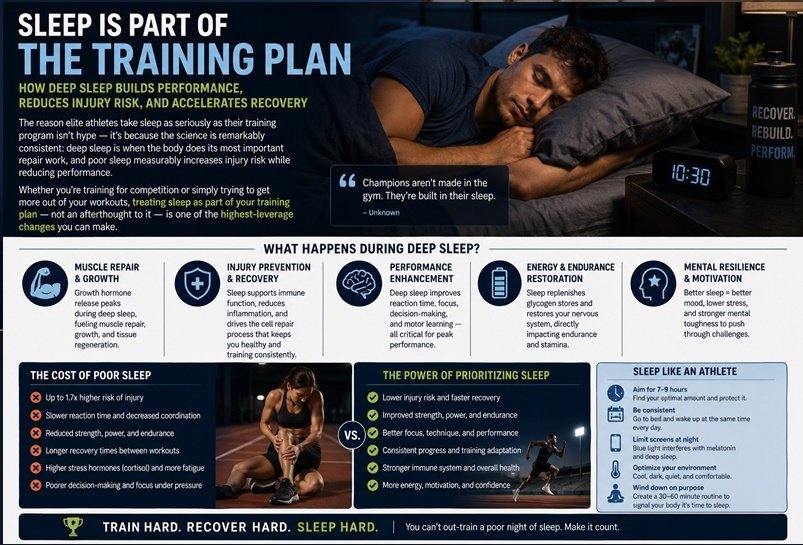
Physical training doesn’t build muscle — it damages it. Growth and repair occur afterward, primarily during deep sleep, when your body releases most of its daily growth hormone. Growth hormone plays a central role in tissue repair, muscle protein synthesis, and recovery from the microscopic damage caused by resistance training and intense exercise.
This means that inadequate deep sleep doesn’t just leave you feeling tired — it directly limits how effectively your body repairs and adapts to training. You can have a perfect workout program and nutrition plan, but if deep sleep is compromised, you’re leaving a significant portion of your training adaptation on the table.
Sleep Deprivation and Injury Risk
Multiple studies on athletic populations, including well-known research on adolescent athletes, have found a clear association between reduced sleep and increased injury risk. The mechanisms are fairly intuitive once you think them through: poor sleep impairs reaction time, coordination, and decision-making — all of which matter enormously in sports involving quick movements, contact, or complex motor skills. A fatigued nervous system simply doesn’t fire and coordinate movement as precisely as a well-rested one.
This is part of why sleep tracking has become standard practice in professional sports organizations — not as a wellness afterthought, but as a genuine risk-management and performance tool.
The Reaction Time and Cognitive Performance Factor
Beyond the physical repair angle, sleep has a measurable effect on reaction time, focus, and decision-making — all directly relevant to athletic performance. Research on sleep-extended athletes (deliberately increasing sleep duration beyond their normal baseline) has documented improvements in sprint times, shooting accuracy, and overall mood and energy, compared to their normal sleep patterns. In sports where split-second decisions and precise motor control matter, the cognitive side of sleep is just as relevant as the physical recovery side.
Why Cortisol Management Matters for Athletes Specifically
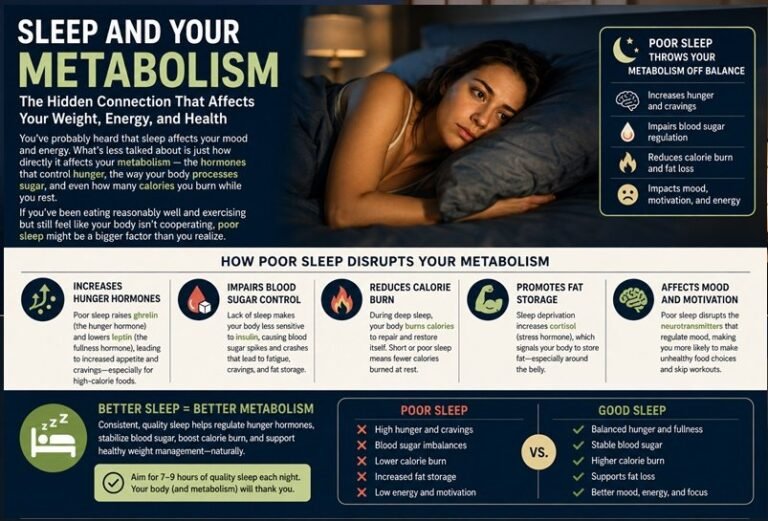
Intense training is itself a physical stressor, and it already elevates cortisol as part of the body’s normal stress response to exercise. Poor sleep compounds this, keeping cortisol elevated for longer than it should be. Chronically elevated cortisol interferes with muscle protein synthesis, impairs immune function (making athletes more susceptible to illness during heavy training blocks), and can contribute to the kind of persistent fatigue and reduced performance often described as overtraining syndrome.
This is one of the more counterintuitive lessons in sports science: more training without adequate recovery, especially sleep, often produces worse results than moderately less training with proper recovery. The body needs the downtime to actually convert training stress into performance gains.
What This Means If You’re Not a Professional Athlete
You don’t need to be competing at an elite level for any of this to apply. Anyone who trains regularly — whether that’s weightlifting, running, team sports, or general fitness — is asking their body to repair and adapt after each session, and that repair process depends heavily on sleep quality, not just quantity.
If you’ve hit a plateau despite consistent training and reasonable nutrition, sleep quality is one of the most commonly overlooked variables. It’s also one of the more fixable ones, compared to genetics or training history.
Practical Sleep Strategies for Active People
Prioritize deep sleep, not just total hours. Eight hours of fragmented, restless sleep isn’t equivalent to eight hours of consolidated, deep sleep for recovery purposes. Supporting sustained melatonin levels through the night — rather than a single early dose that wears off — helps protect the deeper sleep stages later in the night where growth hormone release is concentrated. This is part of the reasoning behind pairing melatonin with red tart cherry extract’s more gradual, naturally sustained release, an approach used in formulas like YuSleep.
Manage post-workout cortisol and nervous system arousal. Intense evening training sessions can leave your nervous system activated well past bedtime, making it harder to transition into the deep relaxation needed for quality sleep. Ingredients that support nervous system calm — like GABA and L-theanine — can help offset this post-exercise activation, supporting a smoother transition into restorative sleep even after a hard training session.
Time your last workout thoughtfully. For many people, training too close to bedtime keeps core body temperature and heart rate elevated in ways that interfere with natural sleep onset. Where your schedule allows, finishing intense training at least a couple of hours before bed gives your body time to wind back down.
Fuel recovery properly in the evening. Going to bed significantly underfed after a hard training session can contribute to disrupted sleep and next-morning fatigue. A balanced evening meal supports both muscle repair and steadier overnight blood sugar, which in turn supports more consistent sleep.
Treat consistency as a training variable, just like your workout program. Athletes plan training cycles deliberately; sleep deserves the same intentionality. A consistent sleep and wake schedule, even on rest days, supports more reliable recovery than an inconsistent pattern of “catching up” on weekends.
Why Recovery-Focused Sleep Support Makes Sense for Active People
Because athletic training already creates additional physical and hormonal stress, active individuals arguably have more to gain from supporting deep, uninterrupted sleep than sedentary individuals do. A formula designed to support both circadian timing (via melatonin and red tart cherry extract) and nervous system calm after a stressful, cortisol-elevating training day (via GABA and L-theanine) addresses two of the most relevant recovery mechanisms directly, rather than simply extending time spent in bed without necessarily improving sleep depth.
Final Thoughts
The reason elite athletes take sleep as seriously as their training program isn’t hype — it’s because the science is remarkably consistent: deep sleep is when the body does its most important repair work, and poor sleep measurably increases injury risk while reducing performance. Whether you’re training for competition or simply trying to get more out of your workouts, treating sleep as part of your training plan — not an afterthought to it — is one of the highest-leverage changes you can make.
>> Watch this video to find out how to have a good sleep!
These statements have not been evaluated by the FDA. This product is not intended to diagnose, treat, cure, or prevent any disease. Consult a healthcare professional before beginning any new training or supplementation regimen.