Surviving the Newborn Years: A Realistic Sleep Guide for Exhausted Parents
Nobody fully prepares you for newborn-stage exhaustion. You can read every article, hear every warning from friends with kids, and still be blindsided by what chronic, fragmented sleep actually feels like once you’re living it. This isn’t a guide promising your baby will suddenly sleep through the night — that timeline is largely outside your control. This is a realistic guide to protecting your own sleep and sanity during a stage that, while temporary, can genuinely feel endless while you’re in it.
First, a Reality Check
If you’re deep in the newborn fog right now, it’s worth hearing plainly: what you’re experiencing is genuinely hard, not a sign you’re doing something wrong. Newborns wake frequently by design — their sleep cycles are shorter than adults’, and frequent waking (especially for feeding) is developmentally normal, particularly in the first three to four months. This period is temporary, even when it doesn’t feel that way at 3 a.m. on night forty-something.
Why Parental Sleep Deprivation Is Uniquely Hard
Ordinary sleep deprivation is disruptive. Newborn-stage sleep deprivation is different because it’s fragmented rather than simply shortened — you’re not just losing hours, you’re losing the ability to complete full sleep cycles, which is often more taxing than the same total number of hours lost to a later bedtime. Waking every two to three hours prevents you from reaching the deeper, more restorative stages of sleep as consistently, which is part of why new parents often feel disproportionately exhausted even relative to their actual total hours slept.
The “Sleep When the Baby Sleeps” Advice — And Why It’s Incomplete
This advice isn’t wrong, but it’s often unrealistic without acknowledgment of why. Daytime naps interrupted by nervous system arousal (worrying about a to-do list, checking on the baby, general new-parent hypervigilance) often don’t provide the same restorative value as nighttime sleep, even if you technically get the hours. If you find yourself lying down during a nap window but unable to actually relax into sleep, you’re not failing at the advice — you’re experiencing something very common.
A more realistic version of this advice: when you do get a nap window, spend the first few minutes actively trying to calm your nervous system — slow breathing, dim lighting, minimal stimulation — rather than assuming sleep will happen automatically just because the opportunity is there.
Splitting Night Duty: A Practical Framework
If you have a partner, dividing nighttime responsibility deliberately — rather than both of you waking for every disturbance — can meaningfully protect each person’s sleep continuity.
Shift-based splitting: One parent handles the first half of the night (e.g., bedtime through 2 a.m.), the other handles the second half, allowing each person at least one uninterrupted stretch of several hours.
Alternating nights: One parent is “on duty” for all nighttime wakings on even nights, the other on odd nights, giving each person full nights of uninterrupted sleep on their off-nights.
For breastfeeding parents: If exclusively breastfeeding limits how much night duty can be split, consider having your partner handle diaper changes and resettling after feeds, or introduce a pumped bottle for one nighttime feed so your partner can fully cover that waking.
There’s no universally “correct” system — what matters is having an explicit plan rather than defaulting to both parents waking for everything, which tends to maximize total sleep disruption for the household.
Protecting the Sleep You Do Get
Since total sleep time is often limited during this stage, protecting the quality of whatever sleep window you do get becomes especially important.
Wind down quickly, not gradually. You likely won’t have the luxury of a long, leisurely bedtime routine. A short, deliberate wind-down — dim lights, a few minutes of quiet, avoiding your phone right before attempting sleep — helps you fall asleep faster during the limited windows available, since you can’t count on a long runway to relax naturally.
Support your nervous system, not just your schedule. New-parent exhaustion often comes paired with an anxious, “half-alert” nervous system, primed to wake at the slightest sound. This is a case where addressing relaxation directly — not just trying to sleep more hours — matters. Calming ingredients like GABA and L-theanine, included in formulas like YuSleep alongside melatonin, are designed to support genuine nervous system calm, which can help you fall back asleep more easily during the inevitable interruptions, rather than lying awake fully alert after every waking.
Be thoughtful about timing if you’re using any sleep support. If you know you’ll likely be woken within a few hours, taking a sleep aid at your normal 30-minutes-before-bed timing still makes sense — the goal isn’t to sleep more deeply than a waking baby will allow, but to fall asleep faster and, ideally, fall back asleep more easily after each waking, protecting more of your limited sleep window.
Check with your doctor if breastfeeding. Any supplement, including natural sleep formulas, should be reviewed with your doctor before use while pregnant or breastfeeding, given the unique considerations of that stage.
Managing Daytime Function on Limited Sleep
Accept that some days will run on caffeine and willpower. This isn’t a failure of planning — it’s the nature of this stage. The goal is minimizing how often this happens, not eliminating it.
Protect at least one non-negotiable recovery point per week. Whether that’s a partner covering an entire night, a family member helping so you can nap uninterrupted, or simply an earlier bedtime one night a week — having one predictable recovery point helps prevent total sleep debt from compounding indefinitely.
Lower the bar deliberately. This is a temporary season where “good enough” needs to replace “optimal” for almost everything outside of caring for your baby and getting what sleep you can. This isn’t giving up — it’s triage, and it’s appropriate for this specific stage of life.
When to Seek Additional Support
If exhaustion is accompanied by persistent sadness, anxiety, difficulty bonding, or thoughts that concern you, this may be beyond typical newborn-stage tiredness and worth discussing with your doctor — postpartum mood and anxiety disorders are common and treatable, and chronic sleep deprivation can both contribute to and be worsened by them. This isn’t something to push through alone.
A Reminder for the Hard Nights
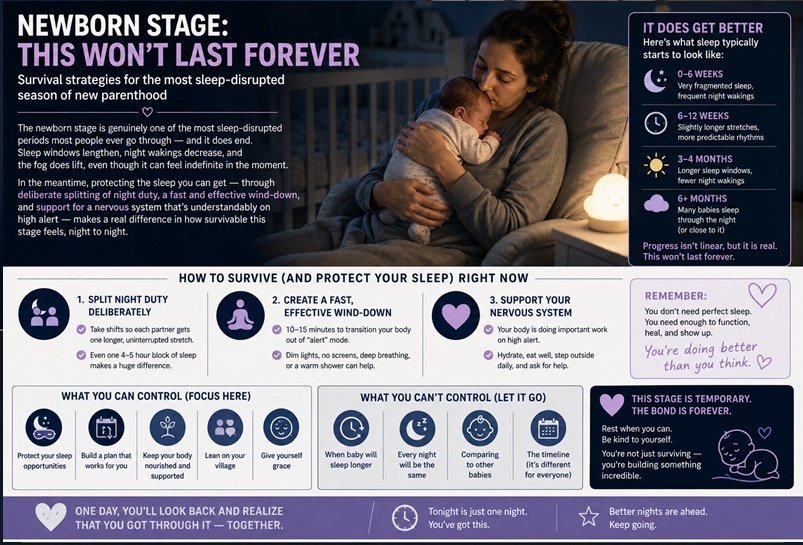
The newborn stage is genuinely one of the most sleep-disrupted periods most people ever go through — and it does end. Sleep windows lengthen, night wakings decrease, and the fog does lift, even though it can feel indefinite in the moment. In the meantime, protecting the sleep you can get — through deliberate splitting of night duty, a fast and effective wind-down, and support for a nervous system that’s understandably on high alert — makes a real difference in how survivable this stage feels, night to night.
>> Watch this video to find out how to have a good sleep!
These statements have not been evaluated by the FDA. This product is not intended to diagnose, treat, cure, or prevent any disease. Always consult your doctor before using any supplement while pregnant or breastfeeding. If you are experiencing symptoms of postpartum depression or anxiety, please reach out to a healthcare provider.