Beating Jet Lag: A Traveler’s Guide to Resetting Your Body Clock
Few things derail a trip faster than jet lag — that disorienting mix of exhaustion, brain fog, and being wide awake at 3 a.m. in a new time zone while everyone around you sleeps soundly. Whether you’re traveling for business and need to be sharp immediately, or you don’t want to lose the first two days of a vacation to grogginess, understanding how jet lag actually works makes it far easier to minimize.
Why Jet Lag Happens
Jet lag occurs because your internal body clock — governed by the suprachiasmatic nucleus in your brain — continues operating on your departure time zone’s schedule even after you’ve physically arrived somewhere new. Your body’s melatonin release, cortisol rhythm, and core temperature cycle are all still synced to the old time zone, creating a mismatch with the local light-dark cycle you’re now experiencing.
As a general rule, your body clock adjusts at a rate of roughly one time zone per day. Cross five time zones, and you’re looking at up to five days for your internal rhythm to fully catch up without any intervention — which is exactly why jet lag can linger well past the point where you’d expect to have simply “gotten over it.”
Eastward vs. Westward Travel: Why One Is Harder
Most travelers find eastward travel (say, flying from the U.S. to Europe) noticeably harder to adjust to than westward travel. This isn’t random — it comes down to how your body clock naturally operates. Left to its own devices, without any light cues, the human circadian rhythm tends to run slightly longer than 24 hours, which makes it naturally easier to delay your schedule (staying up later, as westward travel requires) than to advance it (going to bed earlier, as eastward travel requires).
Knowing this in advance is useful: if you’re traveling eastward, budget extra time and effort for adjustment, since your body is working against its natural tendency.
Start Adjusting Before You Leave
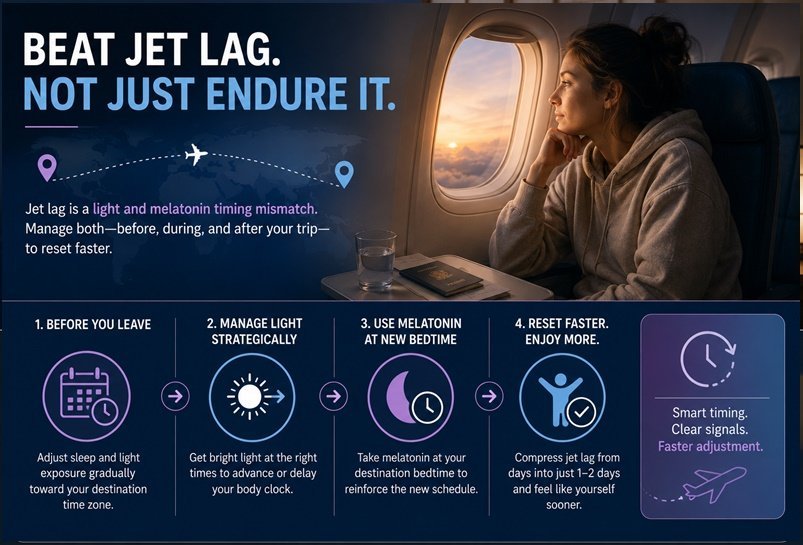
One of the most effective, and most commonly skipped, jet lag strategies is beginning the adjustment before departure rather than after arrival.
For eastward travel (adjusting to an earlier schedule): Shift your bedtime 30–60 minutes earlier each night for two to three nights before departure, and get bright light exposure in the morning while avoiding it in the evening, to help nudge your body clock earlier ahead of time.
For westward travel (adjusting to a later schedule): Shift your bedtime 30–60 minutes later each night before departure, and seek bright light in the evening while avoiding it in the morning.
Even a partial pre-adjustment of one to two hours before you fly can meaningfully reduce how disoriented you feel on arrival.
Light Exposure: Your Most Powerful Tool
Light is the single strongest signal your body clock responds to, more powerful than any supplement or sleep strategy. Managing your light exposure strategically at your destination is the most effective lever for resetting your rhythm quickly.
Traveling east: Seek bright light in the morning at your destination, and avoid bright light (including screens) in the evening for the first several days, to help advance your body clock faster.
Traveling west: Seek bright light in the late afternoon and evening, and avoid intense morning light for the first few days, to help delay your body clock appropriately.
Sunglasses, surprisingly, are a legitimate jet lag tool — wearing them to strategically block unwanted light exposure at certain times of day can meaningfully speed adjustment, particularly on eastward trips.
Managing Sleep on the Plane Itself
Whether to sleep during your flight depends on your destination’s local time relative to when you land.
If you’re landing in the morning or early afternoon local time: Try to sleep during the flight if possible, so you can stay awake and functional through your first local afternoon and evening, then sleep at a normal local bedtime.
If you’re landing at night local time: Try to stay awake during the flight (or nap only briefly), so you’re genuinely tired and ready to sleep once you land at your destination’s nighttime.
Fighting your body’s actual sleep pressure at the wrong time — forcing wakefulness when you should sleep, or vice versa — tends to make the adjustment period longer, not shorter.
>> Get a good sleep with this method!
Supporting Melatonin Timing at Your Destination
Since jet lag is fundamentally a melatonin-timing mismatch, supporting melatonin release at the correct local time can meaningfully speed adjustment. This is one of the few sleep-related uses where a melatonin-containing supplement addresses the actual root mechanism directly, rather than working around it.
Taking a melatonin-supporting formula around 30 minutes before your intended local bedtime — rather than your original home-time-zone bedtime — helps reinforce the new schedule you’re trying to establish, working with the light exposure strategies above rather than replacing them.
A formula like YuSleep, combining melatonin with red tart cherry extract for more sustained release, alongside GABA and L-theanine to help calm the mental restlessness and difficulty settling down that often accompanies jet lag (your mind still running on a different internal schedule even as your body tries to sleep), addresses both the circadian timing mismatch and the nervous system unease that frequently comes with it — a combination particularly well-suited to the jet lag scenario specifically, compared to everyday sleep support.
Practical Timeline: A 3-Day Eastward Adjustment Plan
Day 1 (Arrival): Get bright morning light, stay active and outdoors if possible, avoid napping longer than 20–30 minutes, and take your sleep support formula 30 minutes before local bedtime.
Day 2: Continue morning light exposure, avoid screens and bright light in the evening, maintain the same local bedtime and wake time as Day 1.
Day 3: Most travelers notice a significant improvement by this point, particularly for shorter time zone shifts (3–5 hours). Continue the same routine, and your body clock should be substantially, if not fully, adjusted.
For longer shifts (6+ time zones), extend this same approach for an additional 2–3 days.
What to Avoid
Excess caffeine to power through fatigue. It’s tempting, but heavy caffeine use to combat jet-lag fatigue often just delays proper adjustment by keeping you artificially alert at the wrong times, disrupting your ability to establish the new sleep schedule.
Alcohol on the flight or immediately after arrival. Alcohol disrupts sleep architecture and dehydrates you further during travel, both of which worsen jet lag symptoms rather than helping you relax into a new schedule.
Long naps during the adjustment period. While a short nap (20–30 minutes) can help you get through an initially rough afternoon, longer naps can interfere with your ability to fall asleep at the correct local bedtime, extending the adjustment period.
Final Thoughts
Jet lag isn’t something you simply have to endure until it passes on its own. Understanding that it’s fundamentally a light and melatonin timing mismatch — and strategically managing both, starting before you even leave — can meaningfully compress what would otherwise be a multi-day adjustment period into just a day or two. Pairing smart light exposure with melatonin-timed support at your new local bedtime gives your body the clearest possible signal about which schedule it should actually be running on.
>> Watch this video to find out how to have a good sleep!
These statements have not been evaluated by the FDA. This product is not intended to diagnose, treat, cure, or prevent any disease. Consult a healthcare professional before using melatonin or other supplements for frequent or long-haul travel.