Why Sleep Changes As You Get Older (And How to Adapt)
If your sleep doesn’t feel the way it did in your twenties or thirties, you’re not imagining it, and it’s not simply a matter of “getting used to less.” Sleep genuinely changes with age, in measurable, well-documented ways — and understanding those changes makes it much easier to adapt to them, rather than assuming something has gone wrong.
What Actually Changes
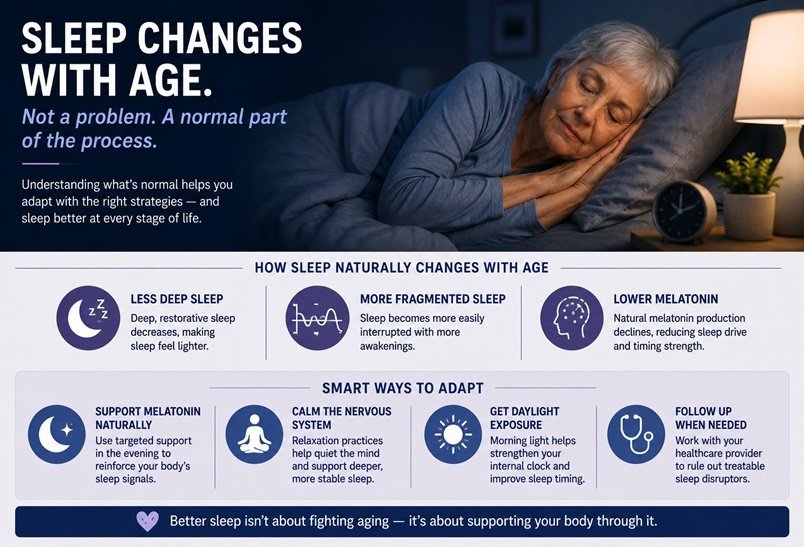
Deep sleep declines. Perhaps the most significant age-related change is a gradual reduction in the amount of deep (slow-wave) sleep your body produces each night. Deep sleep is the stage most associated with physical restoration, and its decline is a normal part of aging — but it also means older adults often wake feeling less physically refreshed than they did when younger, even with a similar total number of hours slept.
Sleep becomes lighter and more fragmented. Alongside less deep sleep, older adults tend to spend more time in lighter sleep stages, which are more easily disrupted by noise, light, temperature changes, or the need to use the bathroom. This is part of why waking up multiple times during the night becomes more common with age — it’s not necessarily a sign of a sleep disorder, but a natural shift in sleep architecture.
Natural melatonin production decreases. Melatonin production tends to decline with age, and the timing of its release can also shift. This contributes both to more difficulty falling asleep for some older adults, and to the well-documented tendency toward earlier bedtimes and earlier wake times as people age — sometimes called a natural “phase advance” in circadian rhythm.
Sleep needs don’t actually decrease much. A common misconception is that older adults simply need less sleep. In reality, most research suggests sleep need remains fairly stable through adulthood — what changes is the ability to achieve consolidated, high-quality sleep, not the underlying biological need for it.
Why This Matters More Than People Realize
These changes aren’t just an inconvenience — sleep quality remains just as important for cognitive function, immune health, mood regulation, and physical recovery in older adults as it is at any other age, arguably more so given the increased importance of these systems for healthy aging. Dismissing age-related sleep difficulty as “just part of getting older, nothing to be done” often means missing genuinely helpful interventions.
Common Sleep Disruptors That Increase With Age
Medications. Many medications commonly prescribed for age-related conditions — certain blood pressure medications, some antidepressants, corticosteroids, and others — can affect sleep as a side effect. If sleep quality has declined noticeably after starting a new medication, it’s worth discussing with your doctor whether the medication itself might be a contributing factor.
Medical conditions. Conditions that become more common with age — chronic pain, arthritis, an enlarged prostate causing nighttime bathroom trips, and sleep-disordered breathing like sleep apnea — can all significantly disrupt sleep, independent of the natural age-related changes described above. These are worth ruling out or addressing directly with a doctor rather than assuming disrupted sleep is simply unavoidable.
Reduced daytime activity and light exposure. Retirement, reduced mobility, or simply spending less time outdoors can mean less of the daytime light exposure and physical activity that help reinforce a strong circadian rhythm — both of which naturally decline in many people’s routines as they age, independent of any medical cause.
What Actually Helps
Support declining natural melatonin production directly. Since melatonin production genuinely decreases with age, supplementing it becomes more directly relevant for older adults than for younger people with naturally robust melatonin levels. Pairing direct melatonin supplementation with red tart cherry extract’s naturally sustained-release melatonin can help support more consistent levels through the night — particularly useful given the more fragmented sleep architecture common with age.
>> https://hop.clickbank.net/?affiliate=napi99&vendor=yusleep&op=buy&tid=yusleepnet!
Address the more fragmented, lighter nature of aging sleep. Since older adults spend more time in lighter, more easily disrupted sleep stages, supporting deeper relaxation and nervous system calm becomes especially relevant — helping the body settle more fully into available deep sleep, rather than hovering in lighter stages more susceptible to disruption. Ingredients like GABA and L-theanine are aimed at exactly this kind of nervous system calming support.
Maximize daytime light exposure. Because daytime light exposure often naturally decreases with age due to lifestyle changes, deliberately seeking bright light exposure — a morning walk outdoors, sitting near a bright window — helps reinforce a stronger circadian signal, partially compensating for reduced natural melatonin production.
Stay physically active, within your ability level. Regular physical activity, even modest amounts appropriate to individual mobility and health status, supports deeper, more consolidated sleep and helps counteract some of the natural age-related decline in sleep quality. This doesn’t need to be intense — consistent, moderate activity has been associated with meaningful sleep quality benefits in older adult populations.
Review medications with your doctor periodically. If sleep quality has changed notably, it’s worth a specific conversation with your doctor about whether any current medications might be contributing, and whether timing adjustments or alternatives might help.
Rule out sleep apnea if symptoms are present. Loud snoring, gasping during sleep, or excessive daytime sleepiness despite adequate time in bed warrant a conversation with a doctor about sleep apnea screening, which becomes more common with age and is a distinct, treatable condition — not something a general sleep supplement is designed to address.
Adjusting Expectations Realistically
Part of adapting well to age-related sleep changes is adjusting expectations alongside making practical changes. Waking once or twice during the night, or naturally waking slightly earlier than you did decades ago, isn’t necessarily a problem to solve — it may simply be a normal part of how your sleep architecture has shifted. The goal isn’t necessarily to sleep exactly like you did at 25; it’s to make sure the sleep you’re getting is as consolidated, restorative, and consistent as possible given where your body is now.
Why a Multi-Ingredient Approach Fits This Life Stage Well
Given that aging affects several sleep-related systems simultaneously — declining natural melatonin, more fragmented sleep architecture, and often reduced daytime light exposure — a formula addressing multiple angles at once tends to align well with what’s actually happening physiologically. A combination like YuSleep, pairing melatonin and red tart cherry extract for circadian and sustained-release support, GABA and L-theanine for deeper nervous system relaxation, and 5-HTP with B vitamins for serotonin balance, is designed to work with several of these age-related changes simultaneously rather than addressing just one.
Final Thoughts
Sleep changes with age aren’t a sign that something has gone wrong — they’re a well-documented, normal part of the aging process, involving reduced deep sleep, more fragmented sleep architecture, and declining natural melatonin production. Understanding these changes makes it possible to adapt intelligently — through targeted support for melatonin and nervous system calm, deliberate daylight exposure, and appropriate medical follow-up when needed — rather than simply accepting worse sleep as an unavoidable cost of getting older.
>> Discover How To Have a Good Sleep at Night – Watch Video!
These statements have not been evaluated by the FDA. This product is not intended to diagnose, treat, cure, or prevent any disease. Always consult your doctor about any new or worsening sleep difficulty, particularly if accompanied by other symptoms, and before starting any new supplement if you take regular medication.