How to Build a Bedroom That Actually Helps You Sleep (In-Depth Guide)
Most people troubleshoot poor sleep by focusing on what they take before bed — a supplement, a cup of tea, maybe a meditation app. Far fewer people take a hard look at the room they’re actually sleeping in. But your bedroom environment is working on your sleep quality every single night, whether you’ve optimized it or not — and often, it’s working against you in ways that are easy to fix once you know what to look for.
Temperature: The Most Underrated Variable
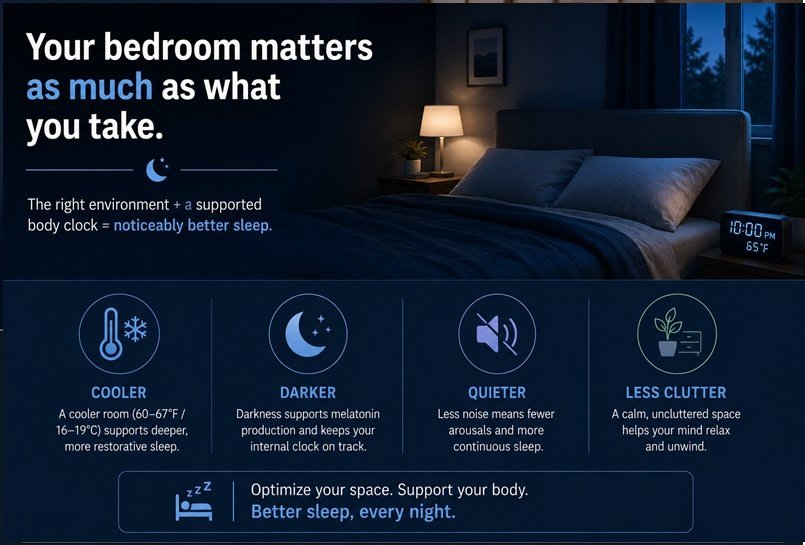
Sleep researchers consistently point to bedroom temperature as one of the most impactful, most overlooked environmental factors. Your core body temperature naturally drops by roughly 1–2°F as part of the process of falling asleep, typically continuing to decline for about two hours after sleep onset, and a room that’s too warm actively works against that natural decline.[^1]
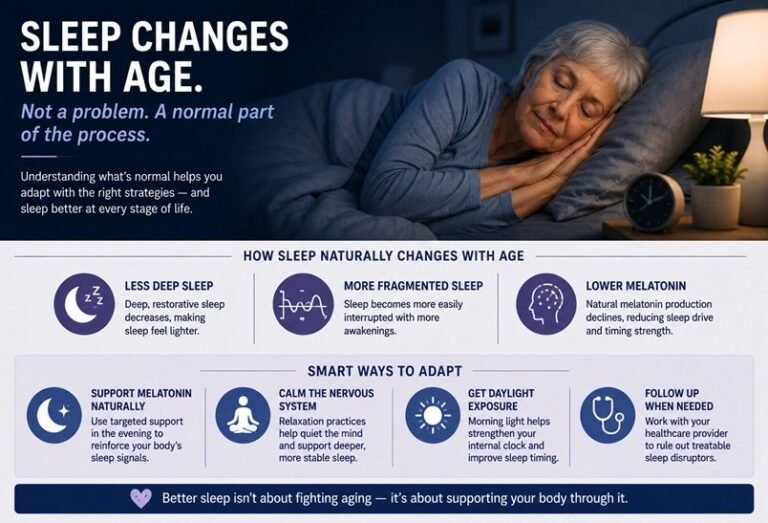
Most major sleep health organizations, including the National Sleep Foundation and American Academy of Sleep Medicine, converge on a range of roughly 60–67°F (15.6–19.4°C) as ideal for most healthy adults, with 65°F often cited as a practical sweet spot.[^1][^2][^3] It’s worth noting this isn’t a flat rule for everyone: research specifically on older adults has found a somewhat warmer range — closer to 70–74°F — associated with the most efficient, restful sleep in that population, likely tied to age-related changes in the body’s ability to regulate temperature.[^4] Sleep quality has also been shown to degrade sharply at temperature extremes in either direction — dropping measurably above roughly 75°F, and again below roughly 54°F, where the body has to divert energy toward maintaining core temperature rather than settling into deep sleep.[^2]
Practical fixes: Lower your thermostat in the evening, use breathable bedding (cotton or linen rather than synthetic materials that trap heat), and consider a fan for both cooling and the added benefit of consistent white noise. If you’re over 65, don’t assume the standard 65°F guidance applies to you directly — a slightly warmer room may genuinely serve you better.
Light: Darkness Isn’t Optional
Even small amounts of light exposure during sleep can suppress melatonin production and disrupt sleep architecture, and this effect is especially well-documented for blue light specifically. Blue light in the roughly 460–480 nanometer range is the primary stimulus for specialized cells in the retina (intrinsically photosensitive retinal ganglion cells, containing a light-sensitive protein called melanopsin) that signal directly to the brain’s master clock to suppress melatonin release.[^5] Because melatonin normally rises in the evening to help facilitate sleep, this suppression delays your circadian phase and measurably increases the time it takes to fall asleep.[^5] Experimental studies have found that even short periods of evening smartphone or tablet use are enough to meaningfully reduce melatonin levels and shift their timing later.[^5][^6]
This isn’t limited to phones and screens — ordinary household lighting matters too. One analysis of common home light sources found that many modern LED lamps produce enough blue-heavy illuminance to cross the threshold associated with meaningful melatonin suppression, even at typical evening brightness levels.[^7] By contrast, research comparing red and blue light exposure found that blue light maintained significant melatonin suppression through several hours of exposure, while red light allowed melatonin levels to substantially recover within the same window — making warm, red-shifted lighting a genuinely better choice for evening use than standard white or blue-toned bulbs.[^8]
Practical fixes: Blackout curtains are one of the highest-impact, lowest-effort upgrades available for sleep quality. If blackout curtains aren’t an option, a comfortable sleep mask is a reasonable substitute. Switch evening lamps to warm-toned or red-shifted bulbs where possible, and cover or turn away any small electronic lights (chargers, alarm clocks, smoke detectors) that create a persistent glow in an otherwise dark room. If you want to keep using screens in the evening, blue-light-blocking glasses have shown mixed but generally positive results in controlled trials — one randomized study found that wearing them for two weeks in the hours before bed led to meaningfully better self-reported sleep quality among people with insomnia symptoms, even though objective sleep-tracking measures didn’t always shift as clearly.[^9]
Noise: Consistency Matters More Than Silence
Contrary to popular belief, complete silence isn’t necessarily the goal — inconsistent noise is generally more disruptive to sleep than constant, predictable background sound. A sudden car alarm or a partner’s occasional snore is more likely to wake you than a steady hum, because your brain treats unpredictable sounds as more worth paying attention to, even during sleep.
Practical fixes: A white noise machine or fan can help mask unpredictable outside noise with a consistent sound your brain learns to tune out. If you live somewhere with variable street or building noise, this single change often produces a bigger improvement than people expect.
Your Mattress and Pillow: When to Actually Replace Them
Most sleep guides recommend replacing a mattress every 7–10 years, though this varies with quality and usage. More useful than a strict timeline is paying attention to specific signs: visible sagging, waking up with new aches that weren’t previously present, or noticeably better sleep quality when sleeping somewhere else (a hotel, a guest bed) are all signals worth taking seriously.
Pillows matter more than people often assume, particularly for neck and shoulder discomfort that can cause repeated micro-wakings throughout the night without you necessarily attributing them to your pillow. The right pillow depends heavily on your typical sleep position — side sleepers generally need a thicker, firmer pillow to keep the neck aligned with the spine, while back and stomach sleepers typically need something thinner.
Clutter and Visual Environment
This one is easy to dismiss as unrelated to sleep science, but there’s a real and growing body of research connecting bedroom clutter to measurably worse sleep. One study following individuals at high risk for hoarding-related clutter found they reported significantly more sleep disturbances and next-day tiredness than people with tidier rooms — researchers noted that poor sleep is already known to affect cognition, so a cluttered, less functional bedroom may compound existing risks for stress and cognitive difficulty.[^10] The Sleep Foundation similarly identifies visual clutter as a documented source of pre-sleep stress, noting that disorganized items in a bedroom can reinforce a subconscious sense of unfinished tasks right before you’re trying to wind down.[^11]
A separate, larger study tracking over 1,000 participants specifically found that adopting a regular bedroom de-cluttering habit was associated with measurably better sleep quality scores and fewer nighttime and daytime sleep-related problems — with benefits appearing after as little as four weeks of consistent practice.[^12] Some researchers point to a plausible mechanism: visual clutter competes for the brain’s attention and cognitive resources in a way similar to background noise, and can keep cortisol — the stress hormone that’s supposed to be declining in the evening — elevated longer than it should be.[^13]
Practical fixes: Keep your bedroom specifically reserved for sleep (and intimacy) rather than work, exercise equipment, or general storage, if space allows. A brief, consistent tidying routine before bed — putting away clothes, clearing your nightstand — can reinforce a visual sense of order and closure to the day, and based on the research above, doesn’t need to be elaborate to produce a measurable benefit.
Air Quality and Humidity
Less commonly discussed, but genuinely relevant: poor air quality or humidity levels that are too high or too low can both disrupt sleep, contributing to congestion, dry throat, or general discomfort that causes repeated waking without an obvious cause. Sleep health guidance commonly recommends targeting a relative humidity of roughly 40–60%, regardless of the temperature setting you’ve chosen.[^3]
Practical fixes: A humidifier in dry climates or during winter heating season, or a dehumidifier in more humid environments, can meaningfully improve comfort. Simply airing out the bedroom during the day, if possible, also helps maintain better air quality overnight.
>> Watch Video and Discover How To Have a Good Sleep at Night!
Electronics: The Modern Sleep Saboteur
Beyond the well-known blue light issue, having your phone within arm’s reach at bedtime creates a persistent temptation and a subtle background alertness — even if you don’t actively check it, its presence alone has been associated with lower-quality sleep in research on phone use and sleep habits.
Practical fixes: Charge your phone outside the bedroom, or at minimum across the room rather than on your nightstand. If you use your phone as an alarm clock, consider a separate, simple alarm clock instead — removing one of the most common reasons people reach for their phone right before or immediately after waking.
Color and Décor: A Smaller, but Real, Factor
While the evidence here is less robust than for temperature, light, and noise, some research suggests that cooler, muted color palettes in a bedroom are associated with modestly better self-reported sleep quality compared to bright, stimulating colors — likely tied to the same general principle of minimizing visual stimulation in the space where you’re trying to wind down.
Building Your Ideal Sleep Environment: A Checklist
- Temperature: 60–67°F (15–19°C), adjusted down in the evening
- Light: Blackout curtains or a sleep mask; covered or dimmed electronic lights
- Noise: Consistent background sound (white noise or fan) rather than aiming for total silence
- Mattress and pillow: Replaced when showing wear, or when waking with new discomfort
- Clutter: A tidy, calm visual environment, ideally reserved primarily for sleep
- Air quality: Appropriate humidity level for your climate
- Electronics: Phone charged outside the bedroom or across the room
Why Environment and Supplementation Work Together
An optimized sleep environment and a natural sleep formula like YuSleep are solving different, complementary parts of the same problem. Your environment removes external obstacles — light, noise, temperature — that would otherwise disrupt sleep regardless of your internal biology. A formula supporting melatonin, nervous system calm through GABA and L-theanine, and serotonin balance through 5-HTP and B vitamins addresses the internal biological side. Neither fully compensates for the other; a poorly optimized bedroom can undercut even a well-formulated supplement’s effectiveness, and vice versa.
Final Thoughts
Most people spend far more effort optimizing what they take before bed than the room they’re actually sleeping in — despite the environment being one of the most consistently supported factors in sleep research. A cooler, darker, quieter, and less cluttered bedroom, paired with supporting your body’s internal sleep systems, tends to produce noticeably better results than addressing either piece alone.
>> Watch Video and Discover How To Have a Good Sleep at Night!
These statements have not been evaluated by the FDA. This product is not intended to diagnose, treat, cure, or prevent any disease. This article is for general informational purposes and is not a substitute for professional medical advice.
References
- Sleep Foundation. “The Best Temperature for Sleep.” https://www.sleepfoundation.org/bedroom-environment/best-temperature-for-sleep
- Eight Sleep. “Should You Really Sleep at 68 Degrees?” https://www.eightsleep.com/blog/should-you-really-sleep-at-68-degrees/
- American Standard. “What’s the Ideal Temperature for Sleep?” https://www.americanstandardair.com/resources/blog/whats-the-ideal-temperature-for-sleep/
- Baniassadi, A. et al. Study on older-adult sleep temperature, reported in WebMD, “For Older Adults, Best Sleep Temp is 70-74 Degrees: Study,” published in Science of the Total Environment. https://www.webmd.com/sleep-disorders/news/20230915/cm/older-adults-best-sleep-temp-study
- Frontiers in Neurology. “Efficacy of blue-light blocking glasses on actigraphic sleep outcomes: a systematic review and meta-analysis.” https://www.ncbi.nlm.nih.gov/pmc/articles/PMC12668929/
- npj Biological Timing and Sleep. “Afternoon to early evening bright light exposure reduces later melatonin production in adolescents.” Nature. https://www.nature.com/articles/s44323-025-00040-6
- Scientific Reports. “Home lighting, blue-light filtering, and their effects on melatonin suppression.” Nature. https://www.nature.com/articles/s41598-025-29882-7
- “Comparative Effects of Red and Blue LED Light on Melatonin Levels During Three-Hour Exposure in Healthy Adults.” https://www.ncbi.nlm.nih.gov/pmc/articles/PMC12113466/
- ScienceDirect. “Effect of evening blue light blocking glasses on subjective and objective sleep in healthy adults: A randomized controlled trial.” https://www.sciencedirect.com/science/article/abs/pii/S2352721821000127
- Today.com / St. Lawrence University research. “Can’t sleep? Try decluttering your bedroom, says a new study.” https://www.today.com/home/why-cant-i-fall-asleep-answer-may-be-your-messy-t25891
- Sleep Foundation. “How to Set Up a Bedroom for Better Sleep.” https://www.sleepfoundation.org/bedroom-environment/how-to-design-the-ideal-bedroom-for-sleep
- Oxford Academic, SLEEP journal. “0373 De-Cluttering the Bedroom as a Possible Sleep Hygiene Step to Improve Sleep Quality.” https://academic.oup.com/sleep/article-abstract/40/suppl_1/A138/3781632
- Go Simplified. “The Science of Sleep: How Decluttering Your Bedroom Can Lead to Better Rest.” https://www.go-simplified.com/blog/the-science-of-sleep-how-decluttering-your-bedroom-can-lead-to-better-rest
Note: These references support general statements about sleep environment research and are provided for informational context. They do not constitute an endorsement of YuSleep specifically by the cited sources. Individual results may vary.