Behind the Formula: What “Made in an FDA-Registered, GMP-Certified Facility” Actually Means (In-Depth Guide)
If you’ve read anything about YuSleep, you’ve likely come across the phrase “manufactured in the USA in an FDA-registered, GMP-certified facility.” It’s a common claim across the supplement industry — which is exactly why it’s worth understanding what it actually means, rather than just taking it at face value. This article breaks down what these terms genuinely represent, what they don’t, and why manufacturing standards matter more than most supplement shoppers realize.
The Legal Framework Behind All of This: DSHEA
To understand why supplement regulation works the way it does, it helps to know where the rules actually come from. The Dietary Supplement Health and Education Act (DSHEA) of 1994 established the fundamental legal framework for regulating dietary supplements in the United States, creating a distinct product category separate from both conventional foods and pharmaceutical drugs.[^1][^2] This is the law that gave the FDA authority to develop manufacturing standards for supplements eventually — but, notably, DSHEA does not require supplements to undergo pre-market approval the way drugs do. This single structural decision explains almost everything else about how supplement quality varies across the industry, and why manufacturing standards end up mattering so much.
What “FDA-Registered” Actually Means
A common misconception is that FDA registration means the FDA has reviewed, tested, or approved a specific product. It hasn’t — and understanding this distinction matters for setting accurate expectations.
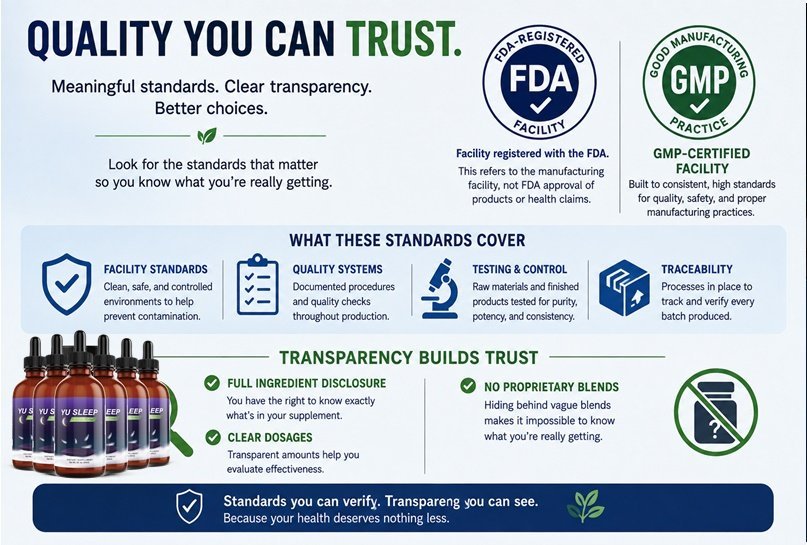
FDA registration applies to the facility, not the individual product. It means the manufacturing facility is on record with the FDA as a food or dietary supplement manufacturer, which subjects it to FDA oversight, including the ability to conduct inspections. This is a meaningful baseline requirement — facilities that aren’t registered are operating outside this regulatory framework entirely — but it’s a facility-level credential, not a product-specific stamp of approval.
Dietary supplements, unlike prescription drugs, don’t go through FDA approval before reaching the market. This is a structural feature of how supplements are regulated in the U.S. under DSHEA, not something unique to any particular brand.[^1] It’s why every legitimate supplement company, YuSleep included, is required to include language stating that its claims “have not been evaluated by the Food and Drug Administration” — this isn’t a hedge specific to one brand; it’s an accurate, legally required disclosure for the entire category.
What “GMP-Certified” Actually Means, in Regulatory Detail
GMP stands for Good Manufacturing Practice, and for dietary supplements specifically, this isn’t just an industry buzzword — it refers to a specific, legally binding federal regulation: 21 CFR Part 111, formally titled “Current Good Manufacturing Practice in Manufacturing, Packaging, Labeling, or Holding Operations for Dietary Supplements,” finalized by the FDA in June 2007.[^3][^4][^5] This regulation is binding and carries the full force of law — it isn’t a voluntary guideline a company can choose to loosely interpret.[^4]
In practical terms, 21 CFR 111 requires companies to, among other things:
- Verify the identity, purity, strength, and composition of every raw ingredient before it’s used in production — meaning a facility can’t simply trust a supplier’s label without independent confirmation.[^6][^7]
- Establish specifications at every critical point in the manufacturing process and determine, through actual testing, whether those specifications are consistently being met.[^8]
- Implement documented quality control operations covering the entire manufacturing, packaging, labeling, and holding process, not just the final product.[^7][^8]
- Maintain proper facility design, equipment cleanliness, and calibration standards, with regular maintenance and validation.[^6]
- Train and qualify personnel involved in manufacturing, packaging, and testing to properly understand and follow these regulations.[^6]
- Take specific measures to prevent microbial contamination, including excluding personnel who could be a contamination risk from sensitive operations.[^9]
According to industry compliance analysis, one of the most common FDA observations during facility inspections in recent years has specifically been failure to properly test raw materials for identity before use — underscoring that even this seemingly basic requirement is a genuine point of failure for facilities that don’t take it seriously.[^6]
Why This Regulatory Structure Exists in the First Place
The 2007 GMP final rule wasn’t issued in a vacuum — it was a direct regulatory response to documented concerns about substandard dietary supplement manufacturing practices and mislabeling across the industry.[^4] In other words, GMP certification exists specifically because, before this regulation, there wasn’t a consistent, enforceable manufacturing standard — and the consequences of that gap (contamination, inconsistent potency, mislabeled products) were significant enough that federal rulemaking followed.
Why Manufacturing Standards Matter More With Supplements Than Most Products
Because dietary supplements aren’t pre-approved by the FDA the way pharmaceutical drugs are, the manufacturing and quality control standards a company voluntarily adheres to become one of the most important indicators of product reliability available to a consumer. Two companies could sell what appears to be an identical product — a bottle listing the same ingredient names — with meaningfully different actual quality, purity, and dosing accuracy, depending entirely on the standards followed during manufacturing.
This is part of why manufacturing transparency is worth paying attention to when evaluating any supplement brand, not just as a marketing checkbox, but as a genuine indicator of what you’re actually putting into your body.
The Proprietary Blend Problem: A Legal Loophole Worth Understanding
This is one of the more important, and more commonly misunderstood, transparency issues in the supplement industry. DSHEA specifically allows companies to list ingredients as part of a “proprietary blend” — disclosing the total combined weight of several ingredients and the names of what’s in the blend, but not the individual amount of each ingredient within it.[^10] This is a legal practice, not a violation, but it has a well-documented downside: because individual doses aren’t disclosed, there’s no way for a consumer — or even a researcher — to know from the label alone whether any single ingredient in the blend is present at an amount large enough to actually produce the effect it’s associated with in research.[^10]
Independent analysis from supplement testing organizations has specifically found that many proprietary blends contain sub-therapeutic (meaning too low to be clinically meaningful) doses of key active ingredients, sometimes padded out with inexpensive filler ingredients to inflate the blend’s total listed weight.[^11] Industry guides on reading supplement labels are increasingly blunt about this: while a proprietary blend is occasionally used to legitimately protect a genuinely unique formulation ratio, in practice the large majority exist specifically to obscure underdosing, and a brand’s refusal to disclose individual amounts is generally treated as a red flag rather than a neutral choice by supplement label analysts.[^12][^13]
This is precisely why full ingredient and dosage transparency — disclosing the exact amount of each individual ingredient, rather than a combined blend total — is considered one of the more meaningful, checkable signals of a higher-quality supplement formulation.
Third-Party Testing: The Layer Beyond GMP
GMP certification confirms a facility follows proper manufacturing processes. It’s worth understanding that this is a different thing from independent, third-party verification that a specific finished product actually matches its label claims. Organizations like NSF International, USP (United States Pharmacopeia), and ConsumerLab conduct independent laboratory testing on finished products, confirming ingredient identity, potency, and purity, and screening for contaminants — testing that exists specifically because, as one industry analysis put it, the FDA does not pre-approve or routinely test supplements before they reach store shelves, leaving this verification gap for independent organizations to fill.[^14][^15]
These certifications aren’t universally required, and their absence doesn’t automatically indicate a problem — many reputable, GMP-compliant brands don’t carry third-party seals simply due to the additional cost and complexity involved. But when present, they represent a meaningful additional layer of verification beyond facility-level GMP compliance alone, since they test the actual finished product rather than only the process used to make it.
>> Start Using Yu Sleep Tonight for the Deep, Restful Sleep Your Body Deserves!!
How This Applies to YuSleep Specifically
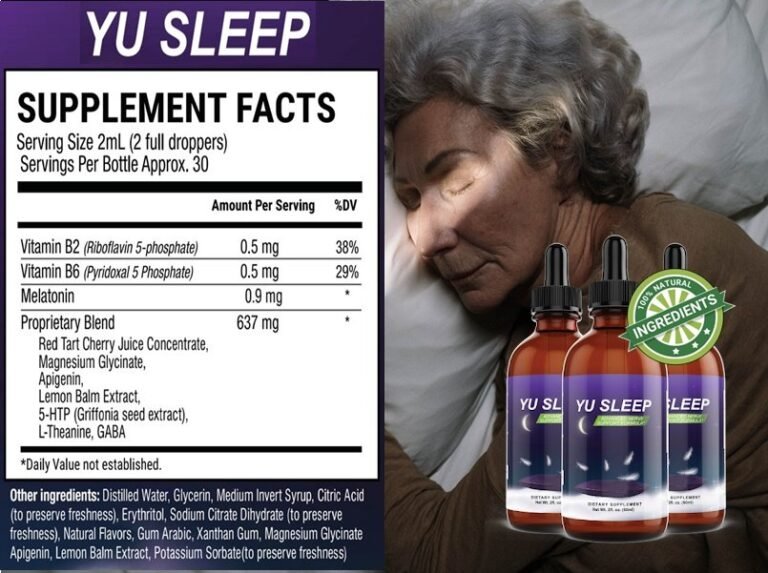
YuSleep’s manufacturing is described as occurring in the USA, in a facility that is both FDA-registered and GMP-certified — the baseline regulatory standard described above under 21 CFR Part 111. The formula itself is disclosed in specific, named amounts across six core ingredients (melatonin, 5-HTP, GABA, L-theanine, red tart cherry extract, and vitamins B6 and B12), rather than a vague, undisclosed “proprietary blend” — a distinction worth noting given everything outlined above about why proprietary blends are treated with skepticism by supplement label analysts specifically because they can mask underdosing.[^10][^11]
Why This Kind of Transparency Should Matter to You as a Consumer
Understanding manufacturing standards isn’t just an academic exercise — it directly affects what you’re actually getting when you take a supplement. A facility that follows 21 CFR 111 protocols is legally required to verify ingredient identity and maintain documented quality control, meaningfully reducing (though not eliminating) the risk of mislabeling and inconsistency problems that originally prompted the regulation.
This is also why buying directly from a brand’s official website, rather than through unverified third-party resellers, matters more than it might seem. Even a legitimately well-manufactured product can be compromised by improper storage, counterfeiting, or expired inventory once it passes through unauthorized reseller channels — issues that exist entirely outside the original manufacturer’s quality control process.
Questions Worth Asking About Any Supplement Brand
Next time you’re evaluating a supplement — YuSleep or otherwise — these are reasonable questions to look for answers to:
- Is the facility FDA-registered and GMP-certified under 21 CFR Part 111?
- Are individual ingredient amounts disclosed, or is it a vague “proprietary blend”?
- Is there real, verifiable contact information and a physical business address?
- Does the company describe any quality control or testing processes?
- Does the product carry any third-party testing certification (NSF, USP, or ConsumerLab), and if not, is that consistent with an otherwise transparent, GMP-compliant brand?
- Is the product sold through a legitimate, verifiable official channel?
Final Thoughts
“FDA-registered, GMP-certified facility” is a genuinely meaningful claim, but understanding what it actually covers — facility-level compliance with a specific, legally binding federal regulation (21 CFR Part 111), not FDA approval of health claims — helps set accurate expectations. Combined with full ingredient and dosage transparency, rather than a vague proprietary blend that industry analysts widely flag as a red flag for underdosing, these standards represent some of the most reliable, checkable signals available for evaluating whether a supplement company takes product quality seriously, in an industry where that diligence isn’t as heavily regulated as many consumers assume.
>> Start Using Yu Sleep Tonight for the Deep, Restful Sleep Your Body Deserves!!
These statements have not been evaluated by the FDA. This product is not intended to diagnose, treat, cure, or prevent any disease. For specific, current details about manufacturing practices, always refer to official brand disclosures.
References
- Natural Products Association. “Dietary Supplement CGMPs (Current Good Manufacturing Practices).” https://www.npanational.org/education/regulatory-framework-and-historical-context/
- International Journal of Pharmaceutical Investigation. “Quality System Requirements of Dietary Supplements: An Overview of 21 CFR Part 111.” https://www.jpionline.org/quality-system-requirements-of-dietary-supplements-an-overview-of-21-cfr-part-11
- U.S. Food and Drug Administration. “Current Good Manufacturing Practices (CGMPs) for Food and Dietary Supplements.” https://www.fda.gov/food/guidance-regulation-food-and-dietary-supplements/current-good-manufacturing-practices-cgmps-food-and-dietary-supplements
- MasterControl. “FDA 21 CFR Part 111.” https://www.mastercontrol.com/compliance/21-cfr-regulations/111/
- eCFR. “21 CFR Part 111 — Current Good Manufacturing Practice in Manufacturing, Packaging, Labeling, or Holding Operations for Dietary Supplements.” https://www.ecfr.gov/current/title-21/chapter-I/subchapter-B/part-111
- CGMP Consulting. “Understanding 21 CFR Part 111 for Dietary Supplement Makers.” https://cgmpconsulting.com/21-cfr-part-111-for-dietary-supplement-makers/
- Capote Law Firm. “Understanding cGMPs (21 CFR Part 111) for Dietary Supplements: Compliance & Best Practices.” https://www.capotelawfirm.com/blog/understanding-cgmps-21-cfr-part-111-ensuring-manufacturing-excellence-in-dietary-suppleme/
- California Department of Public Health. “Dietary Supplement GMP 21 CFR Part 111” (regulation text excerpt). https://www.cdph.ca.gov/Programs/CEH/DFDCS/CDPH%20Document%20Library/FDB/FoodSafetyProgram/DietarySupplements/21CFRPart111.pdf
- U.S. Food and Drug Administration. “Small Entity Compliance Guide: Current Good Manufacturing Practice in Manufacturing, Packaging, Labeling, or Holding Operations for Dietary Supplements.” https://www.fda.gov/regulatory-information/search-fda-guidance-documents/small-entity-compliance-guide-current-good-manufacturing-practice-manufacturing-packaging-labeling
- PMC (National Library of Medicine). “The rationale for use of proprietary blends on dietary supplement labels, and their implications for researchers and consumers.” https://pmc.ncbi.nlm.nih.gov/articles/PMC10196566/
- Cares Digest. “Supplement Labels Decoded: What to Check Before You Buy.” https://caresdigest.com/blog/supplement-labels-guide
- Aeterna Nutrition. “How to Read a Supplement Label: 8 Red Flags to Watch.” https://www.aeternanutrition.com/blogs/blogs/how-to-read-a-supplement-label-8-red-flags-to-watch
- Clean Lifestyle. “How to Read Supplement Labels: What to Look For & What to Avoid.” https://cleanlifestyle.directory/guides/how-to-read-supplement-labels/
- Sighed Effects. “ConsumerLab Certification Explained.” https://www.sighedeffects.com/articles/certifications/consumerlab/
- Topvitamine. “How to Read Supplement Labels: Expert Guide.” https://www.topvitamine.com/blogs/news/unlocking-secrets-supplement-labels-what-consumers-need-to-know
Note: These references support general statements about U.S. dietary supplement regulation and industry practices. They are provided for informational context and do not constitute an endorsement of YuSleep specifically by the cited sources. Regulatory requirements are subject to change; always verify current requirements against official FDA sources.